
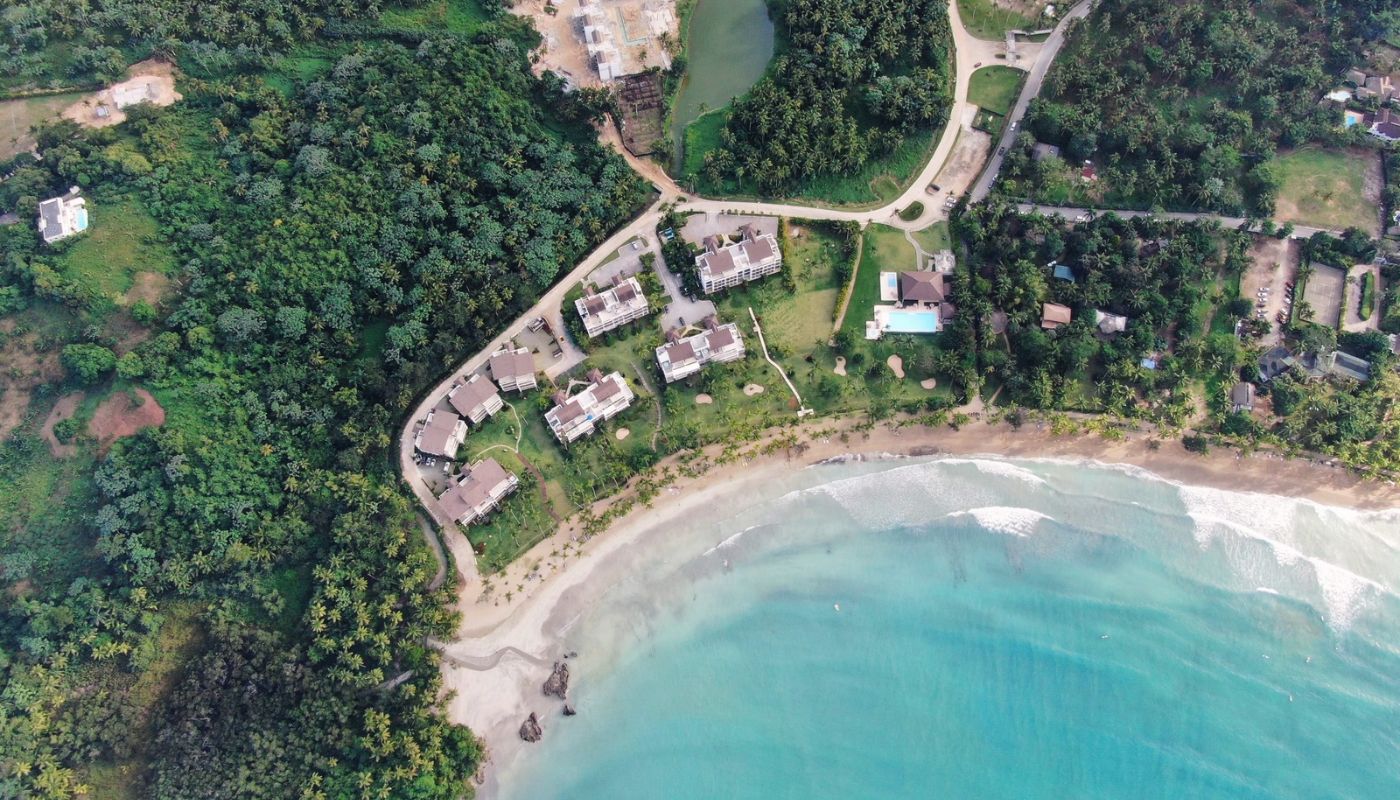
What foreign buyers need to know about property ownership, legal checks, taxes, and the purchase process — from the first viewing to the final title.
You've found the property. Perhaps it's a villa overlooking the Atlantic, an apartment in Las Terrenas, or a piece of land surrounded by tropical forest in Samaná. The price is attractive, the location feels right, and you're beginning to imagine what life here could look like.
Then comes the less romantic part: buying real estate in a country where you may not know the language, the legal system, or the people handling your money.
How do you know the seller actually owns the land? What happens after you sign the contract? And how can you be certain that the property will legally become yours?
The Dominican Republic offers foreign buyers a relatively accessible real estate market, with established ownership rights and a formal land registration system. But an accessible market doesn't mean every transaction is straightforward.
Here's how the process works, what it costs, and where careful buyers should pay the closest attention.
1. Can Foreigners Own Property in the Dominican Republic?
Yes. Foreigners can legally buy, own, sell, and inherit property in the Dominican Republic, generally under the same ownership rules as Dominican citizens.
You don't need Dominican citizenship or residency to purchase a home, apartment, or privately owned land. There's also no general requirement to establish a Dominican company or find a local business partner.
Foreign buyers can hold registered property directly in their own names. The legal framework is established through the Dominican Constitution, Foreign Investment Law No. 16-95, and Real Estate Registration Law No. 108-05.
For most individual buyers, the starting point is a valid passport, an additional official identification document from their country of origin where required for registration, and the appropriate Dominican tax registration. Other documents may be necessary depending on marital status, ownership structure, or whether someone is signing on your behalf.
Importantly, property ownership does not automatically grant residency or citizenship. Immigration status is a separate legal matter.
There are also restrictions that apply to the property itself, regardless of the buyer's nationality. Environmental protections, zoning regulations, building permissions, and registered third-party rights can all affect what can legally be purchased or developed.
This distinction matters. The law may give you the right to own land, but it doesn't guarantee that every plot advertised for sale has clear ownership, approved boundaries, or permission for your intended use.
2. The Most Important Step Happens Before You Sign
Picture two neighboring plots on the Samaná Peninsula. Both overlook the same green hills. Both are advertised as ready for construction.
One has an individually registered title, verified boundaries, and no recorded mortgages. The other is still part of a larger parcel, with its exact boundaries awaiting formal clarification.
From the roadside, you might never notice the difference. Legally, it could determine whether your purchase proceeds smoothly or becomes a complicated dispute.
That's why independent legal due diligence should come before any substantial, non-refundable financial commitment.
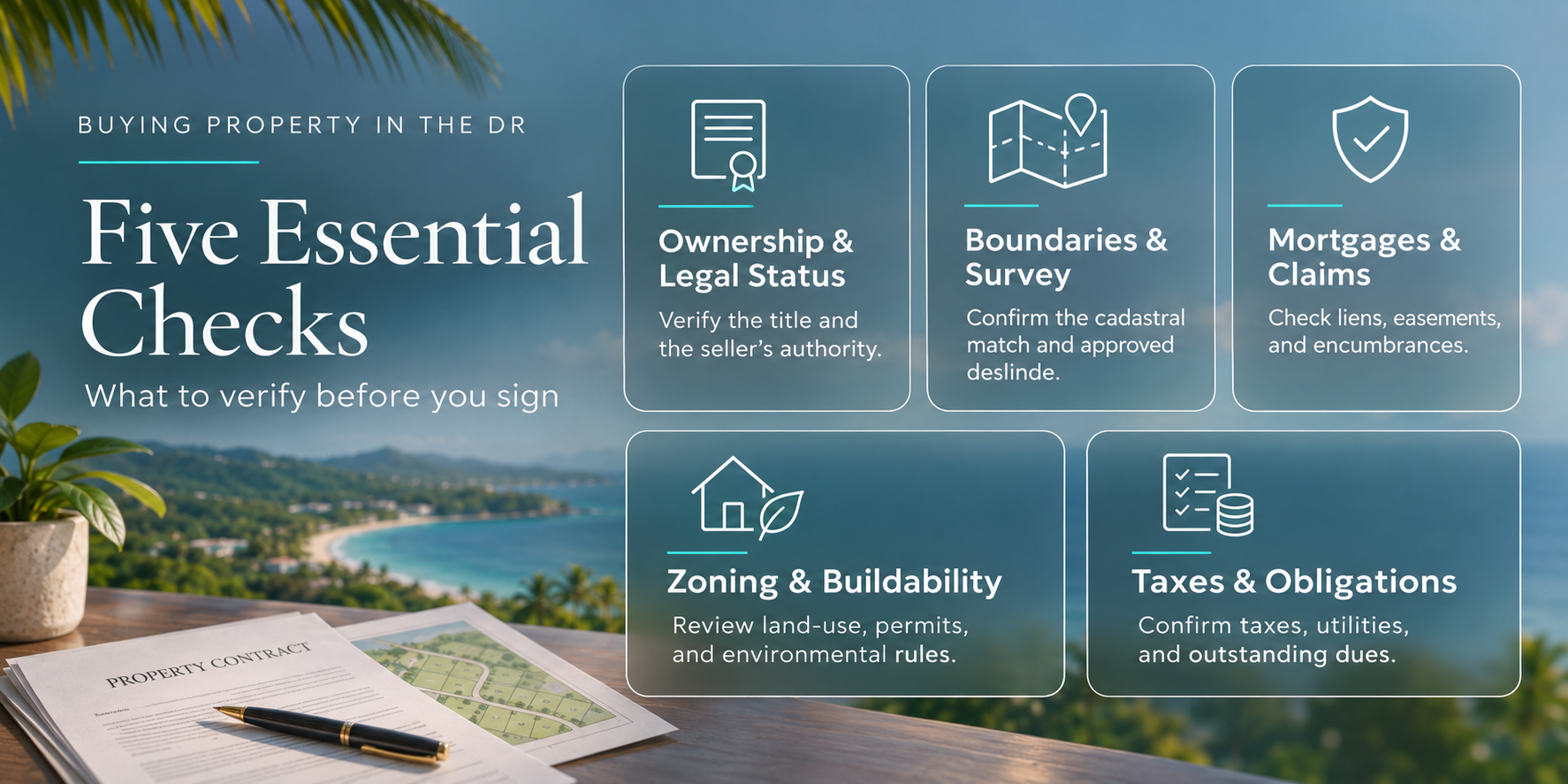
Your Dominican real estate lawyer should investigate five essential areas.
Ownership and legal status. The Certificado de Título identifies the registered property right. The lawyer should verify that the seller has authority to sell and obtain an up-to-date Certificación del Estado Jurídico del Inmueble from the Registry of Title. This official document records the property's legal status, including relevant registered encumbrances.
Boundaries and survey records. The cadastral description must match the actual land being offered. An approved deslinde, where applicable, establishes individual parcel boundaries through the formal survey and registration process. For land purchases, an independent surveyor may be needed to check that the official plans correspond to the physical property.
Mortgages and other claims. Existing mortgages, liens, attachments, easements, or other registered rights can affect a transfer or future use. These should be identified and addressed before closing.
Construction and land use. A legally owned parcel isn't necessarily a buildable parcel. If your plans involve a villa, an expansion, or tourist accommodation, confirm the relevant zoning, permits, and environmental requirements. This is particularly important in ecologically sensitive areas of Samaná, where protected landscapes and development restrictions can affect individual sites.
Taxes and outstanding obligations. Your lawyer should check applicable property tax records, occupancy issues, and obligations that may complicate the transaction. For an existing house, a separate technical inspection of the building and infrastructure is also advisable.
The point is not to turn every property purchase into a forensic investigation. It's to distinguish a problem that can be resolved before closing from one that could follow you for years.
3. How the Purchase Process Works, Step by Step
Although the details differ between a resale, a land purchase, and a newly built home, a typical transaction involving an existing, individually titled property follows a recognizable sequence.
Step 1: Agree on the property and the price
Once you select a property, you negotiate the purchase price, payment arrangements, included assets, and proposed closing conditions.
You should also request the property's title and cadastral information so legal verification can begin.
Some sellers or developers request a reservation deposit. Before paying, establish whether it is refundable, who will hold it, and what happens if due diligence reveals a serious problem.
Step 2: Complete legal verification
Your lawyer examines the documents, investigates the registered ownership, and identifies any issues that need resolving.
This is also the stage to verify the seller's legal authority, especially when the owner is a company or the transaction involves several parties.
A lawyer recommended by an agent or developer may be perfectly competent, but you should be free to appoint an independent professional who represents your interests.
Step 3: Sign the preliminary agreement
Many transactions involve a Promesa de Venta, or promise of sale.
This agreement establishes the commercial and legal commitments before the definitive transfer. It may specify deposits, payment deadlines, title requirements, closing conditions, penalties, and what happens if either party fails to perform.
The exact provisions matter enormously. A deposit described as refundable in conversation may be subject to restrictions in the contract.
Have your lawyer review the agreement before signing.
Step 4: Sign the definitive sale documents and complete payment
When the contractual conditions are satisfied, the parties execute the definitive sale instrument, typically with signatures authenticated by a Dominican notary.
The notary's role is distinct from that of your lawyer. Notarial authentication is an important legal formality, but it does not replace independent investigation of the property.
Payment should follow the agreed contractual schedule, with the final settlement coordinated with signing and document delivery.
There is also a requirement worth knowing about: for covered property transfer instruments executed from May 1, 2025, the Dominican tax authority requires information on payments made and outstanding balances to appear in the transfer instrument or a notarized annex. The rules specify exceptions, including acquisitions valued at RD$1 million or less and certain mortgage-financed purchases.
Dates, amounts, payment methods, and relevant banking details must be recorded as applicable. This follows DGII Notice 17-25, published in August 2025.
For buyers, the practical lesson is simple: use verified payment instructions, retain your banking records, and ensure the documentation accurately reflects the transaction.
Step 5: Pay the transfer tax and register ownership
The tax and registration processes are handled by separate institutions.
The Dirección General de Impuestos Internos (DGII) administers the applicable transfer tax and related fiscal requirements. The Registro de Títulos, part of the Dominican Registro Inmobiliario system, handles registration of the ownership transfer.
The Registry of Title is also responsible for issuing the resulting title documentation.
Signing a sale agreement and completing the registration are not the same thing. The transaction should be followed through until the transfer has been approved and the new ownership documents have been issued.
There is no universal completion time. A straightforward resale with complete documentation is different from a transaction involving a mortgage release, an unresolved survey, or a newly created property title.
What if you're buying from a developer?
Off-plan and newly constructed properties require additional scrutiny because the finished home — and sometimes its individual title — may not yet exist.
Your lawyer should review the developer's rights to the underlying land, the relevant permits, the contractual delivery obligations, and how the final property will be legally registered.
Just as importantly, the agreement must define what you're actually purchasing.
Consider a development such as Nomad City by Samana Group, where buyers may choose a land plot and plan a configurable Flat House villa. The land transaction, construction contract, payment milestones, and eventual handover need to be understood both individually and as parts of the overall purchase.
Is the plot purchased separately from the house? Which company has responsibility for construction? What is included in the quoted price? When are installments due? How are delays handled? When will the relevant title and completion documents be available?
The answers should come from the signed contracts and verified project documentation, not assumptions based on a masterplan or sales presentation.
4. Taxes, Fees, and the Real Cost of Buying
The purchase price is only part of the budget. Dominican real estate transactions involve taxes and professional expenses that should be calculated before signing.
The main acquisition tax is the 3% property transfer tax, generally calculated on the higher of the contractual sale price and the value determined by the tax authorities.
For example, if the applicable taxable value of a property is USD 200,000, the standard 3% transfer tax would be USD 6,000, assuming no exemption applies.
Additional expenses may include legal fees, notarial services, registry charges, surveying, technical inspections, document translations or legalization, and banking or mortgage-related costs.
These expenses vary. Request a written estimate from your lawyer rather than relying on a generic percentage quoted by a seller.
Are there annual property taxes?
Yes, although the amount depends on ownership structure, property classification, value, and applicable exemptions.
For individuals, the Dominican Impuesto al Patrimonio Inmobiliario (IPI) generally applies at a rate of 1% on the combined taxable property value exceeding RD$10,695,494 in 2026, subject to the relevant legal rules and exemptions.
Certain holdings, including some land categories, may receive different treatment. Companies and trusts also have distinct tax considerations.
Properties in qualifying tourism projects may benefit from exemptions under the CONFOTUR framework, established by Law No. 158-01. However, eligibility depends on the project's official classification and the particular benefits that legally apply.
A property being marketed as a tourism investment is not, by itself, proof of tax exemption.
Should you buy personally or through a company?
For many buyers, personal ownership is the simpler arrangement. Others consider a company because of business activities, succession planning, multiple investors, or other circumstances.
Neither structure is universally better.
The right decision depends on the intended use of the property, tax residency, inheritance considerations, financing, and administrative costs — questions worth reviewing with Dominican legal and tax advisers before choosing the ownership structure.
5. What Should You Receive When the Purchase Is Complete?
After paying for a property, buyers understandably focus on receiving the keys. Yet the most important evidence of a completed transaction may arrive in a folder rather than a keyring.
For a standard purchase of an individually titled property, your documentation should include:
The definitive sale agreement or deed, properly executed and notarized as required.
The new Certificate of Title, reflecting your registered ownership.
The relevant survey or cadastral documentation, identifying the acquired property.
Proof of payment of the transfer tax, or documentation of an applicable exemption.
Payment receipts and transaction records, matching the amounts and conditions in your contracts.
Additional documents relevant to the property, such as condominium rules, mortgage releases, construction warranties, or handover records.
For an off-plan purchase, certain documents may only become available upon construction completion or the creation of individual titles. Your contract should clearly identify what will be delivered and when.
Before considering the process finished, ask your lawyer to confirm that the registration has been completed correctly and that the information on the issued title matches the property you purchased.
A Beautiful Property Should Come With a Clear Paper Trail
There's a moment in almost every property search when practical considerations begin to compete with emotion. You find a place that feels right, and suddenly everything else seems like an administrative detail.
In the Dominican Republic, those details deserve attention.
The country gives foreign buyers substantial freedom to own real estate, but a sound purchase still depends on careful legal work, transparent payment arrangements, and properly completed registration.
And perhaps that's the most useful way to approach an international property purchase: don't judge the transaction only by the home you're being shown. Judge it by how clearly the people involved can explain what happens between your first payment and your name appearing on the title.
The view should be a pleasant surprise every morning. The legal paperwork shouldn't be a surprise at all.
Sources and Further Reading
ProDominicana — Investment Guide to the Dominican Republic — foreign investment and property ownership framework.
Registro Inmobiliario — Official FAQs — title certificates, surveys, and registration procedures.
Registro Inmobiliario — Legal Status Certificate — official requirements and description.
DGII — Real Estate Transfer Tax — 3% rate and taxable value.
DGII — Notice 17-25, August 2025 — payment documentation requirements.
DGII — Real Estate Property Tax (IPI) — annual tax and exemptions.
Chambers and Partners — Real Estate 2026: Dominican Republic — legal due diligence, registration, and real estate transaction practices.
Legal and tax information reviewed in November 2026. This article is intended for general information and does not replace transaction-specific legal or tax advice.