

What retirement in the Dominican Republic really costs — from housing and healthcare to residency and Social Security.
Three thousand dollars a month. A pension, perhaps some savings, and a long-standing dream of spending retirement somewhere warm.
Is that enough to live comfortably in the Caribbean?
In the Dominican Republic, it can be. But there's a considerable difference between retiring with a paid-off home, renting a modest apartment, and maintaining an ocean-view villa with a pool.
Samaná offers a particularly appealing setting: tropical landscapes, quieter communities, outdoor activities, and access to the ocean. Yet a sustainable retirement here depends on something less romantic than the scenery — getting the numbers right.
Here's what a realistic budget needs to cover.
1. What Does $2,000, $3,000, or $4,000 a Month Actually Buy?
Start with housing. It will usually be your largest recurring expense, and choosing where and how to live makes a substantial difference.
Rental-market research cited in our Living in Samaná guide found a median advertised rent of approximately $975 for one-bedroom apartments in Las Terrenas in October 2026, with the middle half of listings ranging from $500 to $1,450.
Those figures describe advertised properties in one part of the peninsula, not a standardized rental market across Samaná. Still, they provide a useful reference point for planning.
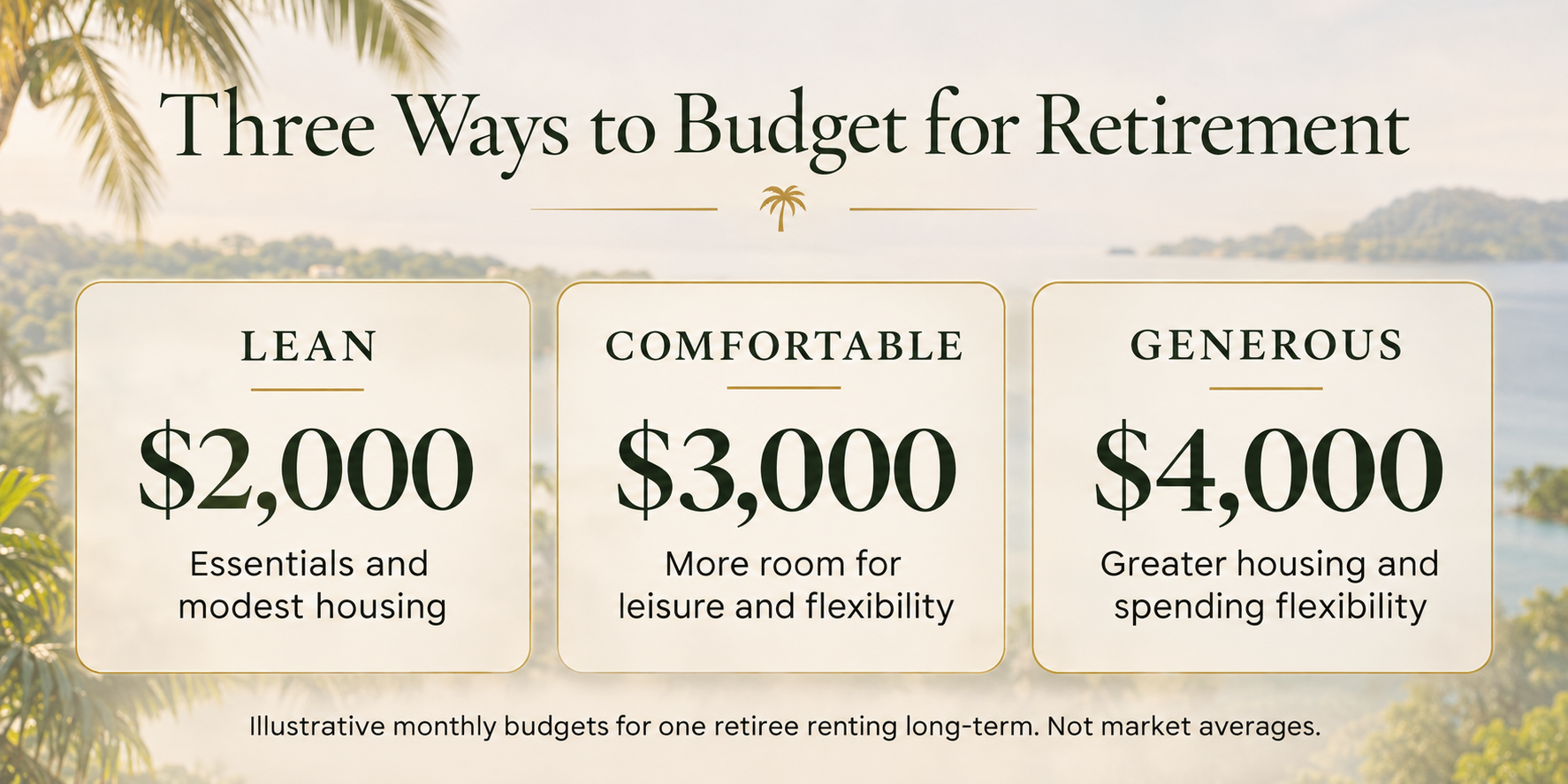
Here are three illustrative budgets for one person renting long-term, with no mortgage or car loan.
Monthly Retirement Budget — Three Scenarios
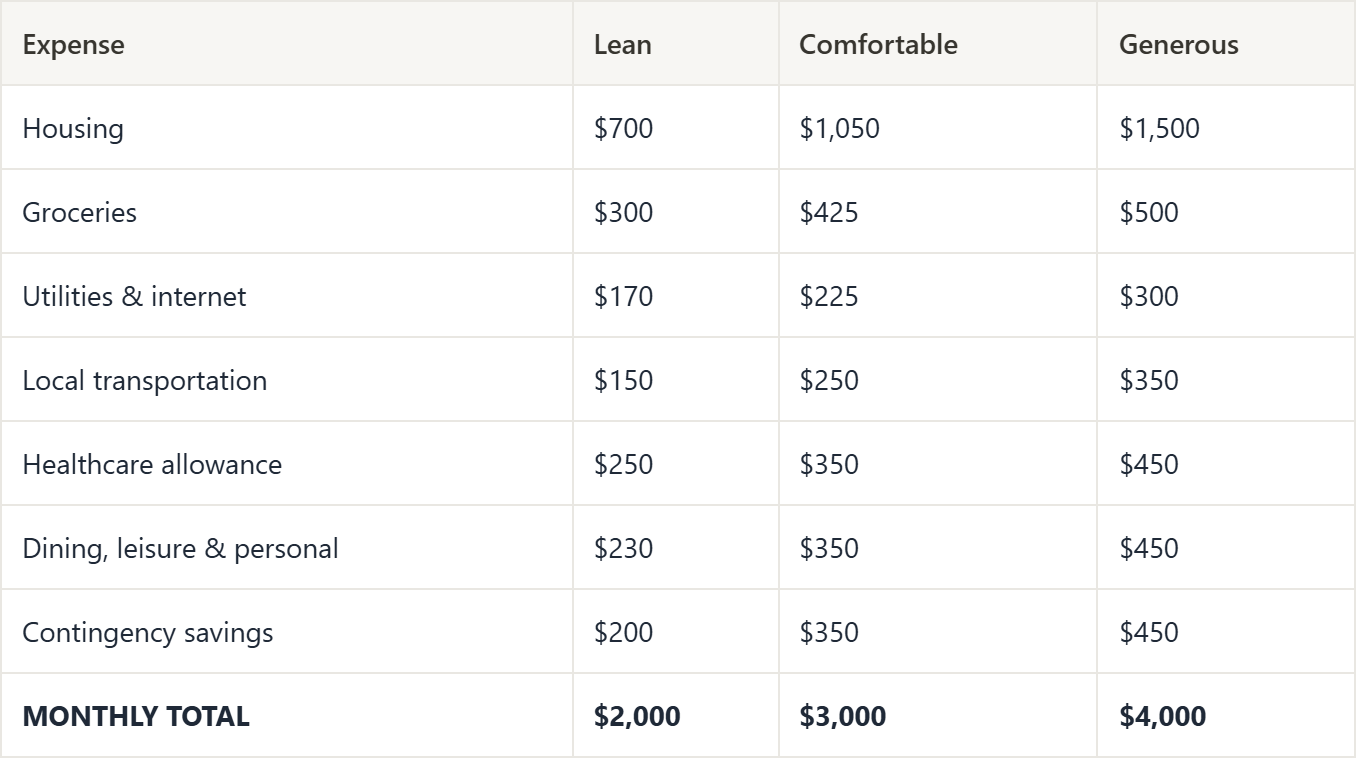
Illustrative 2026 planning scenarios in USD, not measured average household spending or guaranteed market prices. Healthcare allowances are budget provisions, not insurance quotations. Excludes major medical events, international flights, relocation, vehicle purchases, and property acquisition costs.
At $2,000 a month, retirement calls for some discipline: modest accommodation, locally focused shopping, and fewer expensive extras. A large unexpected expense could still stretch the budget.
At $3,000, there's more room for comfortable accommodation, regular dining out, transportation, and everyday recreation.
At $4,000, housing choices and discretionary spending become more flexible, although premium properties and extensive international medical coverage can still push expenses higher.
For couples, shared housing may lower the per-person cost, but food, healthcare, travel, and personal expenses increase. These figures should not simply be treated as a couple's budget.
And if you already own your home? Removing rent changes the calculation significantly — although maintenance, insurance, property taxes, and repairs remain.
2. The Expenses That Can Change Your Retirement Plan
A monthly budget is useful, but three areas deserve closer attention before relocating.
Healthcare comes first. Private insurance premiums depend heavily on age, medical history, benefits, and coverage territory. Published 2026 expat-market estimates suggest that coverage for adults over 65 can run into several hundred dollars per month, with international policies potentially costing considerably more. These are indicative estimates, not insurer quotations.
More importantly, Medicare generally doesn't cover healthcare outside the United States, except in limited circumstances.
Retirees should investigate actual insurance eligibility, pre-existing-condition exclusions, prescription availability, and access to specialist treatment before moving. Some healthcare needs may require travel outside the peninsula.
Homeownership isn't maintenance-free. For retirees considering homeownership, Samana Group's Flat House offers a practical alternative to renting — a home designed for straightforward, low-maintenance living. The base price starts at approximately $250,000, with a total investment of around $350,000 including land, depending on the plot and final specifications. While buying requires a substantial upfront investment, it removes monthly rent from the retirement budget, leaving ongoing maintenance, utilities, insurance, and other ownership costs to consider.

Transport and emergencies matter. Depending on the location, owning a vehicle may be more practical than relying on taxis. International visits to family, medical travel, and unforeseen home repairs also need funding beyond ordinary monthly expenses.
A retirement plan with no cash reserves is vulnerable even when its everyday costs look affordable.
3. Pensionado Residency and Social Security: The Essentials
The Dominican Republic has a dedicated residency route for qualifying foreign pensioners under Law No. 171-07.
According to the Dirección General de Migración, the pensionado category requires a documented foreign pension of at least $1,500 per month, plus $250 for each qualifying direct dependent included in the application.
Applicants must provide supporting documentation, including certified pension evidence, identification, and relevant legalized or apostilled records. The procedure also includes immigration and other administrative requirements.
A separate rentista route generally requires at least $2,000 per month in qualifying foreign-source income. Not every form of income qualifies, so early retirees living from investments should verify their eligibility rather than assuming pensionado status applies.
Law No. 171-07 also provides certain tax and import incentives for eligible beneficiaries, including potential relief connected with a first property purchase. These benefits depend on meeting the legal requirements and obtaining the appropriate approvals.
Can You Receive U.S. Social Security in the Dominican Republic?
Yes, many eligible beneficiaries can.
The U.S. Social Security Administration supports international direct deposit to participating Dominican bank accounts. Eligible beneficiaries may also receive payments into a U.S. bank account while living abroad.
However, payment eligibility depends on individual circumstances, particularly citizenship and benefit type. Supplemental Security Income (SSI) follows different rules and generally cannot continue during long-term residence abroad.
U.S. citizens should also remember that moving overseas does not automatically end U.S. tax-reporting obligations.
The practical approach is to confirm benefit eligibility, banking arrangements, immigration status, and tax treatment before committing to a permanent move.
4. Full-Time Retirement or a Caribbean Winter?
Not everyone needs to relocate permanently.
For a full-time resident, Samaná becomes the primary home. This can simplify everyday routines but requires long-term decisions about healthcare, residency, transportation, and local financial arrangements.
A seasonal snowbird might spend several winter months in the Dominican Republic while maintaining a home elsewhere. It's a way to experience the lifestyle without immediately making a permanent commitment.
The trade-off is maintaining two bases, paying for international travel, and complying with Dominican immigration rules. A tourist entry should not be assumed to provide unrestricted permission for extended residence.
For anyone considering buying property, renting first can be a sensible experiment. A few months in Samaná will tell you far more about daily infrastructure, access to services, and your preferred location than a short vacation.

A Retirement Budget You Can Actually Live With
Retiring in the Caribbean on $2,000–$4,000 a month is possible for some people. The key is understanding what that amount can support — and what it cannot.
Samaná's appeal isn't simply the possibility of spending less. It's the opportunity to spend retirement enjoying nature, pursuing interests, and building a daily life that feels rewarding.
Owning a manageable home can be part of that equation. So can renting, spending only part of the year here, or keeping additional financial reserves rather than investing everything in property.
The best retirement budget isn't the lowest one you can survive on. It's the one that lets you enjoy your life without worrying about every unexpected expense.
Sources and Further Reading
Samana Group — Living in Samaná: 31 Perspectives & Real Insights — 2026 rental listings and local cost references.
Dirección General de Migración — Pensionado Residency — pension requirements and documents.
Dirección General de Migración — Rentista Residency — foreign income requirements.
DGII — Law No. 171-07 — residency-related incentives and tax provisions.
U.S. Social Security Administration — Payments Outside the United States — eligibility and restrictions.
SSA — International Direct Deposit Countries — participating countries.
Medicare — Healthcare Outside the United States — coverage limitations.
DR Living Index — Healthcare Insurance Costs, November 2026 — indicative private insurance ranges, subject to individual quotations.
Information reviewed in November 2026. Budgets are illustrative planning examples, not individual financial, immigration, legal, or medical advice.