

What if you could keep your career, grow your business, and still have time to enjoy the life you're working so hard to build?
There's a strange contradiction in modern success. We work harder to afford more freedom, then become too busy to enjoy it.
The calendar fills up. Vacations turn into remote working sessions. Even a quiet Sunday comes with the feeling that we should be doing something productive.
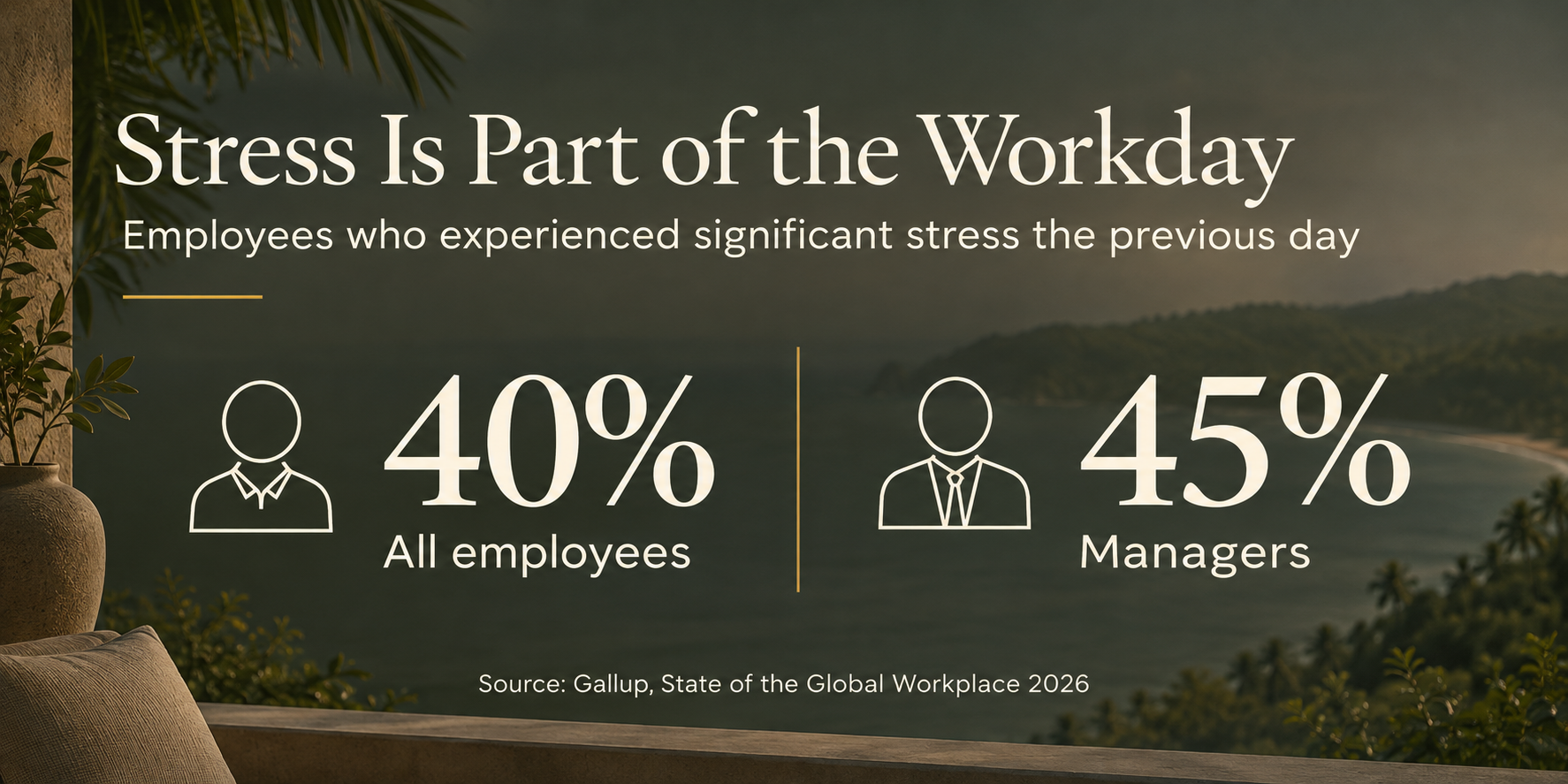
According to Gallup's State of the Global Workplace 2026, 40% of employees worldwide experienced significant stress the previous day. Among managers, that figure reached 45%.
For many professionals and entrepreneurs, the question is no longer how to achieve more. It's whether the life they've built is worth the energy it takes to maintain.
This is where Samaná, on the northeastern coast of the Dominican Republic, enters the conversation. Not as an escape from ambition, but as an opportunity to rethink the relationship between work, time, and everything outside the office.
Because slowing down doesn't necessarily mean earning less. Sometimes, it means changing the economics of how you live.
1. You Can't Outsource Burnout to a Beach
Imagine trading your city apartment for a house overlooking the ocean. You wake up to birdsong, open your laptop on the terrace, and start answering emails.
By sunset, you're still on a video call. The scenery has changed, but your working day hasn't.
It's an easy trap: assuming that a better environment automatically creates a better life.
The consequences of overwork are well documented. A joint WHO and International Labour Organization study found that working 55 hours or more per week was associated with a 35% higher risk of stroke and a 17% higher risk of dying from ischemic heart disease compared with working 35–40 hours.
These findings aren't an argument against ambition. They're a reminder that time and energy are resources worth protecting.
Moving to Samaná won't magically solve burnout. But it can create the space to reconsider habits that once seemed non-negotiable. Does every meeting require your presence? Does your business really need you available around the clock?
The beach won't answer those questions. But it might give you a reason to start asking them.
2. Three Ways to Make It Work
The idea of living in the Caribbean often comes with an unnecessary assumption: that you have to retire, sell your business, or abandon your professional ambitions to make it happen.
For many people, none of that is necessary.
In fact, the changing nature of work has made it increasingly possible to build a career without organizing your entire life around an office.
Eurofound's 2026 research found that teleworking and greater control over working hours were associated with better work–life balance and lower burnout. The benefits, however, depend on maintaining boundaries between professional and personal time.
So what could this look like in Samaná?
The Remote Professional
For consultants, freelancers, and employees with location-independent roles, the transition may be relatively straightforward: keep existing clients or employment while changing where and how the working day happens.
The opportunity is greater flexibility, particularly for people who can work asynchronously and avoid spending entire days in meetings.
The challenge? Time-zone differences, dependable connectivity, and the temptation to remain permanently available. A clear schedule and backup internet connection are essentials, not luxuries.
The Business Owner
For entrepreneurs, relocating can become an opportunity to rethink the way a company operates.
Instead of managing every detail personally, the founder builds stronger systems, delegates decisions, and concentrates on strategy, relationships, and growth.
This model has a significant catch: it only works when the business can function without its owner constantly intervening. If every decision still lands on your desk, you'll simply recreate the same exhausting routine under palm trees.
The Financially Independent
For those with sufficient savings, investment income, or established revenue streams, slowing down may mean choosing work based on interest rather than financial necessity.
Consulting, mentoring, developing a personal project, or investing in new ventures can remain part of life, without filling the entire week.
The essential condition is financial resilience: dependable resources, realistic planning, and enough flexibility to handle unexpected expenses.
These three paths differ, but none requires giving up professional identity.
They do require preparation. Long-term stays, remote employment, business activities, and foreign income can raise immigration and tax questions, so the appropriate arrangements should be checked individually.
The bigger point is that career growth and quality of life don't have to compete for every hour of your day.
3. The Parts of Paradise Nobody Puts in a Brochure
Samaná offers something increasingly difficult to find in major cities: extraordinary nature within easy reach of everyday life.
Tropical forests, quiet beaches, mountain trails, and the ocean create opportunities for a routine built around more than work. A morning swim, a hike, or an afternoon outdoors doesn't have to be reserved for holidays.
There's also the human side: building friendships, discovering local traditions, getting involved in community activities, and forming connections outside your professional circle.
But the experience comes with practical compromises.
Electricity and connectivity require attention, especially for remote workers. A 2026 study of Dominican electricity infrastructure documented continuing reliability challenges, including outages affecting Samaná. A backup power supply and a second internet connection can make an important difference.
Healthcare deserves planning, too. Access to specialist treatment and advanced facilities varies by location, and some medical needs may require traveling beyond the peninsula.
Climate and bureaucracy take adjustment. Tropical humidity, heavy rainfall, administrative procedures, and a different pace of services can frustrate anyone expecting everything to run exactly as it did back home.
And community doesn't happen automatically. Moving somewhere beautiful doesn't guarantee meaningful friendships. Learning Spanish, participating in local life, and building relationships take time and effort.

None of these realities cancels out the appeal of Samaná. They simply make the decision more personal.
For some people, the right balance might be a permanent relocation. For others, spending part of the year here while keeping professional and family ties elsewhere.
The point isn't to find a place without complications. It's to find one where the advantages genuinely matter to you.
The Real Return on Your Time
We measure business success in revenue, growth, and financial returns. Yet we rarely apply the same discipline to the resource we're spending to achieve them: our time.
How much of it goes toward building the life we want? And how much do we actually spend living it?
Samaná won't make those decisions for you. But it offers a compelling setting in which to make them differently — without necessarily sacrificing your career, ambitions, or financial independence.
Perhaps the real luxury of Samaná isn't a villa overlooking the ocean.
It's having an ordinary Tuesday that you don't need a vacation to recover from.
Sources and Further Reading
Gallup — State of the Global Workplace 2026 — worldwide workplace stress and management trends.
Eurofound — Working Anytime, Anywhere (2026) — working-time autonomy, teleworking, and work–life balance.
WHO & ILO — Long Working Hours and Health Risks — research on cardiovascular risks associated with long working hours.
International Journal of Disaster Risk Reduction — Energy Reliability in the Dominican Republic (2026) — electricity reliability and regional outage data.
Research reviewed in November 2026.